Showing posts with label Models. Show all posts

Tuesday, January 24, 2012

Wheels Keep on Turning / The Dance of the Spokes

Back around 1979 in an Illustration class in Art School , we were given an assignment after being exposed to the art of Marcel Duchamp. I don't remember the perimeters of the assignment other than this being one of the things I came up with.


My generation grew up building models. Marcel poked fun at the art world. This was my way at poking fun at him,"conceptual art", and the model kits of the sixties.

Marcel Duchamp is considered by some as one of the most influential artists of the 20th century. Before you laugh, you have to consider that he was poking fun at the art establishment but, also the first (for better or worst), to experiment with "conceptual art", decades before the term was ever coined.

Marcel's words from a website I found: "In 1913 I had the happy idea to fasten a bicycle wheel to a kitchen stool and watch it turn."


The two sides of the box I made. Having fun with how those old AMT and Revell model kits were sold as Three in One.

He continues, "The Bicycle Wheel is my first Readymade, so much so that at first it wasn't even called a Readymade. It still had little to do with the idea of the Readymade. Rather it had more to do with the idea of chance. In a way, it was simply letting things go by themselves and having a sort of created atmosphere in a studio, an apartment where you live. Probably, to help your ideas come out of your head. To set the wheel turning was very soothing, very comforting, a sort of opening of avenues on other things than material life of every day. I liked the idea of having a bicycle wheel in my studio. I enjoyed looking at it, just as I enjoyed looking at the flames dancing in a fireplace. It was like having a fireplace in my studio, the movement of the wheel reminded me of the movement of flames".


My miniature was based on the one above he made in 1951 for MOMA New York. In many ways it's the the most significant one, since it was the first to be exhibited to the art world. I'm guessing it was the one I saw in my class and art history book.

Duchamp said that the Bicycle Wheel was a "personal experiment", which was never intended to be shown to the public and wasn't formally shown in a gallery space until 1951.


The original Bicycle Wheel (l1913 France), was lost. The one to the left (also lost), was the first recreation made after Duchamp came to the USA in 1916. Many mistakingly refer to the 1916 version as the original since it's the first photographed. No, that's not me (on the right), in my studio. It's Marcel wearing a lampshade with a later recreation of the 1916 version in the sixties.

Since 1951 a few more Bicycle Wheel replicas were made. In Milan 1964, 8 were made based on the 1916 version under Duchamp's supervision and were signed. I came across one that was auctioned off for $1.7 million!


For my wheel, I used the front wheel off a Revell Chopped Hog Harley model. The fork is a cut down top fork tree from the Highway Patrol Harley model with model trees bent as legs. The stool was scratch built from balsa wood, wood dowels, and toothpicks.

Too me, there is something about the juxtaposition of the two objects. I also wonder if I'm the only one that can appreciate this strange combination of models from the sixties and art.

Now, before you shrug his concept off as stupid, think about it. 1. It wasn't Duchamp, rather the art community that made big deal of his Readymades. 2. It was a thinking machine for him to get ideas turning in his head. 3. Who can resist touching and turning a wheel? Who hasn't played with spinning a wheel, or been mesmerized by the criss cross visual flicker of the dance of the spokes?

Thursday, June 10, 2010

This Month's Header


The Candy Box
What do models have to do with Summer? Well, when I was a kid, if we couldn't go to the beach, or playing various games in the street, we built stuff. As a matter of fact, my brothers and I were fairly avid car modelers. Most of the time we just couldn't help but modify them to the extent that they rarely resembled what was on the box cover.


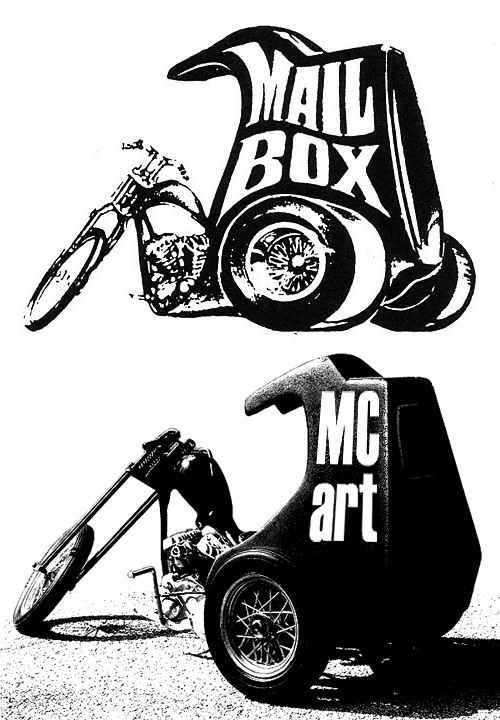
I built this model sometime around 1970-71. It was it's second build and was loosely based on Roth's Mail Box.

When my interest shifted, I stopped building cars and started building bikes. The first one I remember was Revell's "Chopped Hog". At first it was built as it came, but since it was a lousy depiction of a chopper, I quickly tore it apart and customized it. I added a hard tail, a molded in peanut tank, new pipes, sissy bar, rear fender, seat, and scratch built a brass springer.

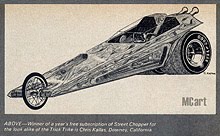
The next victim was Revell's CHP model. I don't recall ever building it stock. Instead, it became the raw material for a chopper based on Jim Breo's trike from the first issue of Big Bike magazine. I posted Jim's trike here last January.

As in real life, a cop bike becomes a donor.


Here's how it looked the first time around. In someways I wish I left it alone.

Like most of my models, it didn't stay intact long, and soon it was apart for a new build based on Roth's Mail Box. Since, I had already modified the Shovelhead frame and engine to look like a 45 c.i. Servi-car. The new mods consisted mainly of stretching the down tube, molding a cut down gas tank, building a body, and adding a longer springer.

The Real Deal. The Crosley engine really only looks good from this side. Roth didn't want to use another flathead 45 since he had already built the Candy Wagon. Each trike project was built to gain more experience. The Crosley engine was an experiment for using a water cooled engine with the radiator mounted in the back and served as a stepping stone towards the later V-8 powered trikes.


Roth's original Choppers magazine used Ed Newton's Mail Box drawing at the top of the letter's to the editor page. For fun, I took a shot at replicating it.


Engine and frame mod details. The cam cover was cut down and the timer centered. The barrels, heads, and push rods were cut down and filed to resemble flathead cylinders. Drag pipe were fashioned from other pipe pieces. This is the second oil tank and was made from a rear shock capped on each end with a spotlight. Now, the only part of the frame left intact was under the engine and trans and the seat post. The drive chain was moved to the right side. Rear fender mounts were used as 45 brake and clutch side straps. Some parts, like the kicker, brake pedal and foot pegs, have broken off over the years. A top engine mount was never made.


The finned heads were scratch built from sheet plastic. Cutting and fitting each fin and the bolt pattern was the most tedious chore. The carb was moved to the left and a working choke was made from a pin. The primary cover was also reworked to resemble a 45's. The left side engine case was the biggest omission, it should be finned. The spark plugs wires and coil have since come off.

The body was made from balsa wood and the interior is covered with vinyl. The gas tank is from a Triumph kit. To create the indents, the knee pads were cut off and glued inside on the opposite sides. The fork was scratch built out of brass and was from another model I built. I don't remember ever seeing a color photo of the real trike back then, but read it was fogged in various colors. My attempt at custom paint was fogging some red over the green Testors metal flake and was never very happy with the result.

The Candy Box. Another fun exercise, a Photoshoped Candy Wagon/Mail Box combination for comparison. You can definitely see the Candy Wagon's influence on my model.

I still have remnants of other chopper models but, somehow this one survived. It was tossed around and stored in a box for about two decades but has since been on display in my studio for about the last 6 years. I'd like to rebuild some of the others, but that will have to wait for a future Summer.... perhaps in a second childhood?

Saturday, June 20, 2009

More Model Madness


Love this box art. It's So much better than just photos of the model. Too bad illustration is So dead today.


Period cool, or cool period. Reflects a time when Harley's were put on a diet.


I remember it sold this way. Same kit less one ... and box, Not as much fun. Why don't they re-release these models? This stuff helped some of us get started on this path.

Thursday, June 11, 2009

Revell's Chopped Hog


Cool box art. I bought this model when it first came out in 1968-69?


A corporate idea of a chopper? The design of this bike wasn't exactly spot on.


At first I did build the kit this way. Later I built it into a proper chopper with molded rigid frame and peanut tank. I still have the engine trans and a few other pieces of it.